
Getting a truck stuck in thick mud can happen surprisingly quickly. One moment the vehicle is moving slowly; the next, the tires are spinning while the truck sinks deeper into the soft ground.
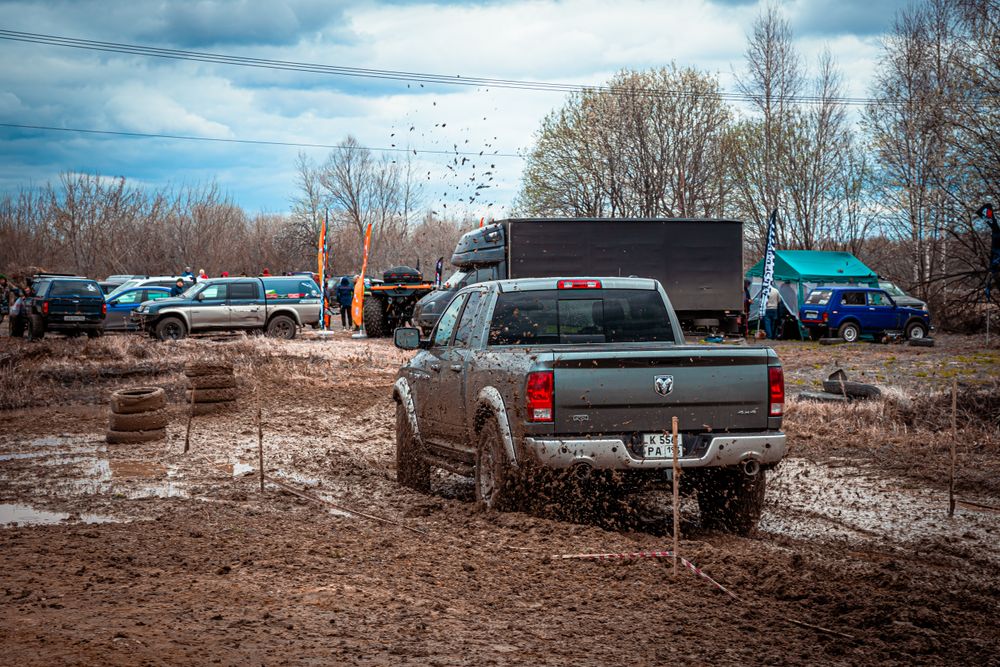
Adding more throttle is rarely the answer.
The longer the tires spin without producing forward movement, the deeper they can excavate the mud beneath them. A sensible recovery starts by stopping the wheelspin, identifying the problem, and creating a path for the truck to regain traction.
Stop Spinning the Tires
The first recovery step is simple: ease off the accelerator.
Spinning tires can transform a difficult situation into a much worse one. As the tread digs through the mud, the tire may sink into a cavity that becomes increasingly difficult to escape.
Once forward movement has stopped, take a moment to assess the vehicle.
Is the truck sitting on its chassis? Are the drive tires buried? Is one side sitting deeper than the other? Is there firmer ground nearby?
Answering these questions helps determine the appropriate recovery method.
Determine Why the Truck Is Stuck
Not every stuck truck has the same problem.
A vehicle may lose traction because the mud is exceptionally slick. Another may become immobilized because its tires have sunk several inches into soft soil. A truck with adequate tire grip can still become stuck if its differential or chassis settles onto the ground.
Look beneath the vehicle only when it is safe to do so. Check whether mud is packed around the tires, axles, or underbody.
If the truck has simply lost traction, additional grip may solve the problem. If it is high-centered, however, adding traction alone may accomplish very little.
Assess the Mud Around the Truck
Before attempting another drive-out, examine the immediate area.
Identify which direction offers the firmest escape route. In some cases, reversing along the path that the truck used to enter the mud is easier than continuing forward.
Look for deeper ruts and water-filled depressions. Thick mud can hide rocks, branches, holes, and other obstacles that may damage tires or underbody components.
Avoid blindly changing direction.
A poorly chosen recovery route can leave the truck even deeper in the mud.
Clear Mud From the Drive Tires
A shovel can be one of the most useful recovery tools in thick mud.
Remove enough material from around the drive tires to give them room to rotate without immediately digging into a deep cavity. Clear the area in the intended direction of travel as well.
If possible, create a gradual ramp rather than a vertical wall of mud.
The aim is to give the tires something to climb onto.
Do not spend unnecessary effort clearing mud if the truck is severely high-centered. In that situation, the chassis itself may be preventing the tires from generating enough downward force to move the vehicle.
Create a Better Exit Path
When the tires cannot grip the existing surface, creating a more favorable path can make a substantial difference.
Depending on the situation, traction boards, suitable natural materials, or a dedicated traction device can provide a firmer interface between the tire and the ground.
The path should be aligned with the intended direction of travel. Remove obstacles that could catch beneath the vehicle and avoid placing unstable objects beneath heavily loaded tires.
A recovery path does not need to be elaborate. It simply needs to provide enough support for the tires to regain traction and climb out of the soft section.
Use Controlled Throttle and Gearing
Once the recovery path is prepared, use smooth power.
Select the appropriate four-wheel-drive mode and gearing for the vehicle and terrain. Low-range gearing can provide useful control during slow recovery operations when the vehicle is equipped for it.
Apply the accelerator gradually.
If the tires immediately spin again, back off rather than increasing throttle. The objective is to convert engine power into forward movement, not tire speed.
In some situations, a gentle rocking motion between forward and reverse can help the truck move. This should only be done within the vehicle manufacturer’s operating recommendations and without abrupt gear changes.
Add Traction When the Tires Cannot Grip
Sometimes the mud is simply too soft for the tires to generate sufficient traction.
A commercial truck traction aid can provide an additional contact surface when conventional tire grip is no longer enough. The TruckClaws Commercial Truck Kit is designed as a recovery traction solution for larger vehicles encountering difficult terrain.
A traction aid should be used according to the manufacturer’s instructions and treated as recovery equipment rather than a substitute for careful route selection.
Install the device while the vehicle is stationary and keep people clear of the vehicle’s immediate recovery area. Once the truck begins moving, use controlled power rather than aggressive acceleration.
The goal is to regain movement and reach firm ground.
Prepare Emergency Recovery Equipment
The best time to prepare for a muddy recovery is before the truck becomes stuck.
Keeping suitable emergency truck recovery equipment onboard can reduce dependence on outside assistance. A recovery setup may include a shovel, rated recovery straps, appropriate connectors, gloves, tire-pressure equipment, and a suitable traction aid.
Equipment should be inspected periodically and stored where it can be accessed quickly.
Drivers should also know how each recovery item works before entering remote or muddy terrain. Familiarity matters when visibility is poor and the vehicle is already immobilized.
Recover the Truck With Another Vehicle
If another capable vehicle is available, a controlled recovery may be possible.
Before connecting anything, identify the designated recovery points on both vehicles. Use equipment with an appropriate working load limit and follow the manufacturer’s instructions.
Never attach a recovery strap to an unsuitable component simply because it is convenient.
During the recovery, keep everyone away from the direct line of tension. Recovery equipment can move violently if a component fails.
The assisting vehicle should apply steady, controlled force rather than attempting an aggressive launch. If the stuck truck begins moving, the driver should maintain appropriate steering and throttle control.
Once the vehicle reaches firm ground, stop and disconnect the recovery equipment safely.
Know When to Stop Trying
Repeated recovery attempts can make the situation worse.
If the truck continues sinking, the chassis is resting heavily on the ground, or the available recovery equipment is inadequate, stop applying power.
Continuing to spin the tires can deepen the ruts and increase the amount of work required to recover the vehicle.
Professional recovery may be the safest option when the truck is heavily buried or located in an unsafe position.
A successful recovery is not measured by how aggressively the vehicle was extracted. It is measured by getting the truck and everyone nearby out safely.
Inspect the Truck After Recovery
Once the truck is free, inspect it before returning to normal driving.
Check the tires and wheels for damage. Look underneath for packed mud around the axles, suspension, steering components, and underbody.
Mud can also accumulate around cooling components and interfere with airflow.
Pay attention to unusual vibration, steering changes, braking problems, or unfamiliar mechanical noises. These can indicate damage that occurred during the recovery.
Clean the truck when practical, restore the tires to their appropriate road pressure, and verify that the vehicle operates normally before continuing the journey.
Conclusion
Recovering a truck from thick mud requires restraint more than brute force. When the tires keep spinning, adding throttle usually makes the problem worse.
Stop the wheelspin, inspect the terrain, clear the drive tires, create a suitable escape path, and introduce additional traction when necessary. Proper recovery equipment can make a major difference, particularly when traveling through remote areas.
Most importantly, recognize when the situation has exceeded the truck’s available traction and recovery capability. Stopping early can prevent a minor stuck situation from becoming a complicated recovery.