Fashion trends used to move top-down. A designer showed something on a runway, it filtered into high street shops months later, and everyone bought roughly the same version of it. That’s not really how it works anymore, at least not for a big chunk of what people actually wear day to day. The biggest shift in recent seasons isn’t a colour or a silhouette, it’s personalisation, people wanting clothing that’s been made or altered specifically for them, rather than picked identical off a rail alongside a thousand other identical rails in a thousand other shops.
From Uniform Dressing to Individual Pieces
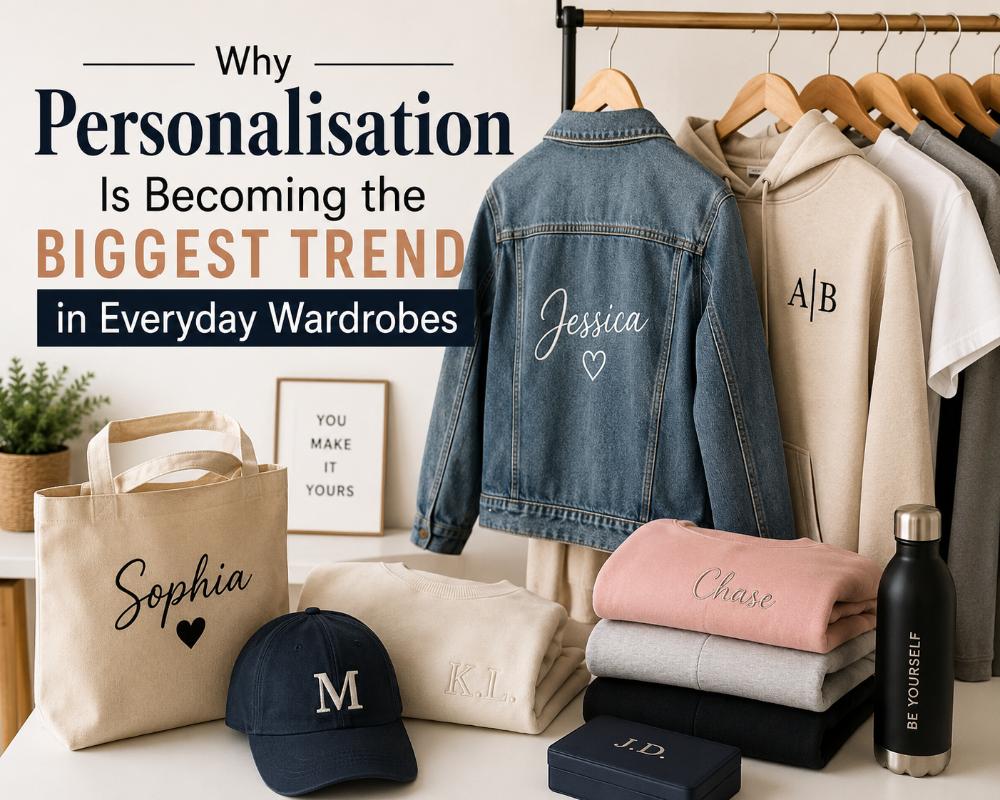
Scroll through any street style feed and the outfits that stand out rarely come from a single brand head to toe. It’s a vintage find paired with something custom, a plain piece elevated with a name, initial, or small design added specifically for that person. Personalised clothing UK shoppers are increasingly drawn to has quietly become one of the easiest ways to make an outfit feel like it belongs to someone, in a landscape where fast fashion means thousands of people could technically be wearing the exact same top on the same day.
This isn’t limited to high-end customisation either. A big part of the shift has happened at the accessible end, printed and embroidered pieces made in small runs or as one-off orders, rather than only through expensive tailoring or luxury monogramming services that used to be the only route to something genuinely individual. What used to be a birthday treat or a one-off splurge has become something people build into ordinary wardrobe decisions.
The Rise of Custom Printed T-Shirts
Custom printed t-shirts sit right at the centre of this shift, and it’s worth understanding why they’ve become so central to how personalisation actually plays out in practice. A t-shirt is one of the simplest garments to customise, it’s flat, affordable, and forgiving of different print techniques, which makes it the natural starting point for anyone testing out a design idea, whether that’s a piece of their own artwork, a phrase that means something to them, or a photo turned into a graphic.
Because a t-shirt is also low-commitment compared to something like a jacket or a coat, it’s become the entry point for people who wouldn’t necessarily think of themselves as into fashion customisation but end up trying it anyway, for a gift, a one-off event shirt, or simply because they saw a design they liked and wanted it on something they could actually wear.
Why DTF Printing Changed What’s Possible
A lot of this trend comes down to how printing technology has changed behind the scenes, even if most people buying a custom t-shirt never think about the process itself. Producing a single customised garment used to be disproportionately expensive, because the setup cost for printing or stitching a design was the same whether someone ordered one item or a hundred. That made true one-off pieces something only bigger brands or specialist tailors could realistically offer at a sensible price.
DTF printing, direct-to-film, changed that by removing most of that setup cost. The design is printed onto a film first, then transferred onto the garment with heat, without needing a new screen prepared for every colour the way traditional screen printing requires. A single hoodie with a custom design, or a t-shirt with someone’s name added, can now be produced without the person ordering it paying for the privilege of being the only customer. This is a big part of why personalised t-shirts and similar one-off pieces have moved from a novelty gift idea into something people order casually, for themselves as much as anyone else, without needing to justify it as a special occasion purchase.
Where Embroidered Apparel Fits Into This Differently to Print
Print gets most of the attention in personalisation because it’s fast and flexible, good for detailed designs, photos, or graphics that would be difficult to recreate any other way. But embroidered apparel has its own distinct place in this trend, particularly for pieces meant to last rather than be worn a handful of times and set aside.
A small embroidered initial on a jacket collar or an embroidered name on a cap reads differently to a printed version, quieter, a little more considered, closer in spirit to how personalisation has always worked in more traditional tailoring. It also holds up far better over years of wear rather than fading or cracking after a dozen washes, which matters for anyone treating a personalised piece as something to keep rather than something disposable. That durability is part of why embroidery has stayed relevant even as print technology has improved dramatically, it suits pieces people genuinely intend to hold onto.
Custom Streetwear and the Blend of Personal and Trend-Led Design
One of the more interesting places this trend has landed is custom streetwear, where personalisation and trend-led design overlap rather than sit apart from each other. Streetwear has always leaned on limited runs and drops that create scarcity, and small batch customisation fits naturally into that culture. A hoodie printed in a run of ten rather than mass produced in the thousands carries some of that same appeal, it’s not about being expensive, it’s about not being identical to what everyone else is wearing.
This has also blurred the line between buying a brand and building one. A growing number of people creating their own small streetwear labels, sometimes just a single design sold to friends and followers, rely entirely on the kind of small batch, low minimum order printing that wouldn’t have been financially realistic a few years ago. It’s given a route into designing and selling clothing that doesn’t require the capital or scale that used to be the barrier to entry.
Personalisation as Identity, Not Just Decoration
What’s interesting about this trend is that it isn’t really about logos or branding the way merchandise or workwear personalisation tends to be. It’s closer to how people used to embroider initials onto handkerchiefs or add pins to a jacket, a small marker that says something belongs to a specific person, made with them in mind rather than mass produced for anyone who happens to buy it.
This shows up in small ways across a lot of wardrobes now. A hoodie with a nickname stitched inside the hem, visible only to the person wearing it. A jacket with a small symbol that means something personal rather than decorative. A t-shirt printed with a design someone made themselves rather than chosen from a catalogue of pre-approved graphics. None of it needs to be expensive or elaborate to have that effect, it just needs to be specific to the person wearing it, which is a different kind of value to what fashion has traditionally sold.
What to Think About Before Ordering a Personalised Piece
For anyone trying this for the first time, a few things are worth knowing before placing an order.
Fabric and fit matter more than the design itself in the long run. A brilliant print on a poorly fitted or thin garment still won’t get worn much, so it’s worth choosing the base piece with the same care as the design going on it.
Print suits detailed, colourful, or photographic designs, while embroidery suits smaller, simpler marks meant to last. Matching the technique to the design, rather than defaulting to whichever is cheaper, tends to produce a better result.
Ask about proofing before a design goes into production. Colours on screen don’t always translate exactly onto fabric, and checking beforehand avoids disappointment with a piece that can’t easily be redone.
Where This Is Likely Heading
As small batch and single-item production keeps getting more accessible, it’s likely personalisation stops being treated as a separate category, a gift shop novelty or a birthday present idea, and becomes something built into how people shop for clothing generally. Choosing a plain garment and adding something specific to it may end up feeling as normal as choosing a size or a colour, rather than a special request reserved for occasions.
For anyone wanting to try this without much commitment, the easiest starting point is usually a single custom piece through a UK supplier that handles both print and embroidery, such as Brandum, rather than committing to a full wardrobe overhaul around the idea.