
A fragrance wheel is a circular chart that sorts perfumes into families based on how they smell, so scents placed near each other share notes, while scents on opposite sides smell almost nothing alike. The most common version splits perfumes into four main families – floral, oriental (often called amber), woody, and fresh – with smaller sub-families branching off from each one. Once someone knows where a bottle sits on the chart, guessing whether a new perfume will suit their taste gets a lot easier, since neighboring segments almost always share common notes.
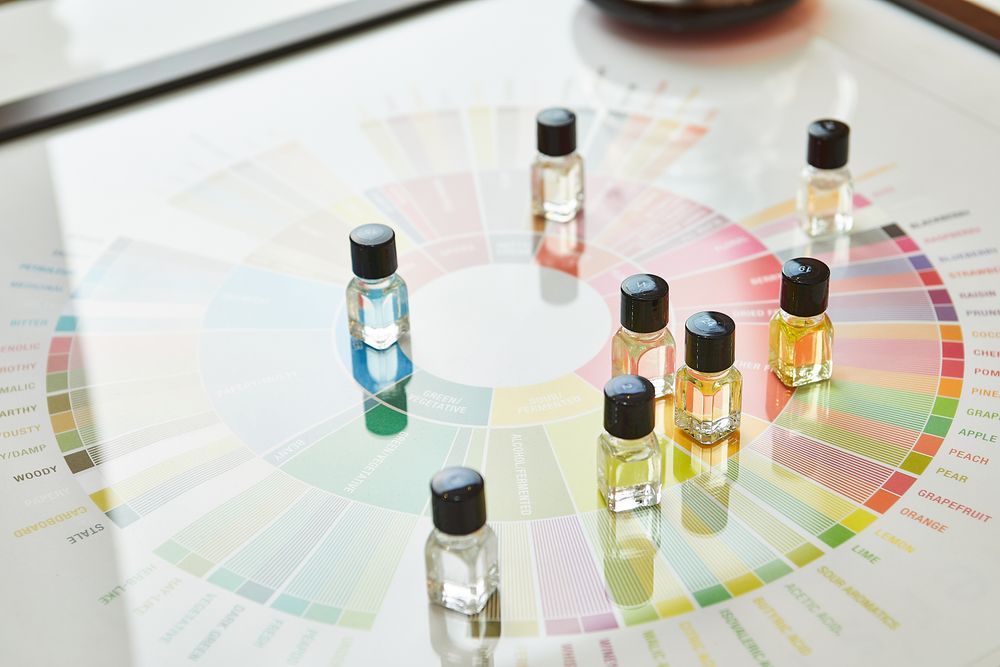
This guide walks through how the system works, why perfume counters and fragrance brands rely on it, how the four families split into smaller groups, and how terms like perfume wheel, scent wheel, and aromatic wheel relate to the same idea, along with a short FAQ covering the questions people search for most.
What Is This Circular Scent Chart?
This classification tool was created by fragrance expert Michael Edwards in the early 1990s to solve a practical retail problem: sales staff needed a fast way to recommend a similar scent whenever a customer’s favorite was out of stock. Placing perfumes on a circle rather than a plain list let shoppers see, at a glance, which scents sat closest to something they already liked.
A Short History Of The System
Edwards began cataloguing perfumes in 1983 with a small guide listing a few hundred fragrances, and the circular diagram itself debuted almost a decade later. Since then, the database behind it has grown to cover tens of thousands of scents, and new sub-families – such as Water and Fruity – have been added as perfumery trends shifted over the years. That long history is part of why the fragrance wheel is still treated as an industry standard today rather than a one-off marketing chart that fades out of use.
The Four Main Scent Families
Nearly every classification chart, no matter which brand or retailer publishes it, tends to organize scents around the same four core groups:
| Family | Core Notes | Overall Feel |
| Floral | Rose, jasmine, lily | Soft and powdery to rich and heady |
| Oriental (Amber) | Vanilla, resin, amber | Warm, sweet, often spicy |
| Woody | Sandalwood, cedar, vetiver, patchouli | Grounded, earthy, used as a base layer |
| Fresh | Citrus, green, aquatic notes | Clean and light |
These four groups sit across from each other on the circle, and the sub-families fill in the space between them, which is exactly why the diagram is drawn as a wheel rather than laid out as a simple list.
How Sub-Families Fill Out The Full Picture
This layered structure gets far more useful once sub-families are added, since two perfumes both labeled “floral” can still smell quite different from one another. Sub-families narrow that gap by blending traits from two neighboring groups:
- Soft Floral – floral notes blended with a powdery or musky base, sitting between Floral and Oriental.
- Floral Oriental – flowers paired with warm spice or amber, bridging Floral and Oriental directly.
- Mossy Woods (often labeled Chypre) – earthy, mossy notes layered with woody depth.
- Aromatic Fougère – herbal and lavender-driven notes common in many classic men’s scents.
- Water (Aquatic) – a lighter branch of the Fresh family built on marine or ozonic notes.
Anyone who enjoyed a Soft Floral perfume can scan the neighboring segment and land on something in the Floral Oriental group with a strong chance of liking it too. Many perfume counters keep a printed fragrance wheel on hand, and shoppers who want to compare notes side by side can browse a similar layout before choosing a bottle.
Fragrance Wheel, Perfume Wheel, Scent Wheel, Aromatic Wheel: Are They The Same?
These four terms get used almost interchangeably, and that overlap is one of the most common points of confusion for anyone new to perfume shopping:
- The original term is the phrase most closely tied to Michael Edwards’ diagram and remains the name used across most of the perfume industry.
- Scent wheel and perfume wheel are simply alternate names for the same style of chart, often preferred by retailers or bloggers who like plainer wording.
- Aromatic wheel sometimes points to the same four-family layout, though it can also describe smaller charts built for a narrower purpose, such as sorting essential oils or wine notes rather than finished perfumes.
So while a narrower classification chart might be built for a more specific goal, the logic driving it stays the same no matter which of the four names ends up on the label.
The Chemistry Behind The Categories
Grouping scents by family is not just a retail habit; researchers have been testing whether these groupings hold up to closer inspection. A 2026 multi-omics study published in Horticulture Research built a sensory-based wheel to classify fragrance types across thirty flower varieties, then linked each category to the actual volatile compounds behind the scent. The team identified six distinct fragrance types, each tied to a measurable chemical signature, which is a strong sign that family groupings track real chemistry rather than acting as a naming convenience.
Scent also shapes buying behavior directly. A 2026 consumer study from the University of Tennessee found that fragrance was a major factor in whether shoppers engaged with a product and eventually completed a purchase, alongside visual appeal and the option to handle the item first.
A quick summary of what both studies pointed to:
- Wheel-style sensory categories lined up with measurable differences in volatile compounds, not just subjective impressions.
- Scent alone was enough to change how long shoppers engaged with a product before buying.
- Sensory classification tools are gaining traction well beyond the perfume counter, including in horticulture and consumer research.
How To Shop Using This Chart
Turning the diagram into a practical shopping habit only takes a few steps:
- Start with a scent already worn and liked, then locate its family and sub-family on the chart.
- Check the neighboring segments rather than jumping across the circle, since adjacent groups share the most notes.
- Test small samples before buying full bottles, since skin chemistry can shift how a note from any given family actually wears on any two people.
Where Else This Kind Of Chart Shows Up
Perfume shopping is the most common use, but the same layout appears in a few other places too:
- Fragrance classes and perfumery training programs, where students learn to identify families by nose.
- Subscription sample boxes, which often tag each scent with its family so customers can track their preferences.
- Personal collection tracking, where a wearer logs bottles by family to spot patterns in what they keep reaching for.
A Quick Note On Chart Variations Across Brands
Not every retailer or fragrance house draws this diagram the same way. Some brands add extra sub-families for niche categories like gourmand or leather, while others simplify the layout down to the four core groups for beginners. None of these variations change the underlying logic; they simply adjust how finely the categories are sliced.
Frequently Asked Questions
What is the fragrance wheel used for?
It’s used to group perfumes by shared scent characteristics, mainly so shoppers and sales staff can find alternatives to a favorite fragrance or predict how a new one might smell before trying it.
How many main scent families does this classification system use?
Most versions use four main families – Floral, Oriental (Amber), Woody, and Fresh – with several sub-families branching out from each one.
Is this style of scent classification scientifically accurate?
It’s based on perceptual similarity rather than a strict scientific formula, though recent sensory research has shown that wheel-style classifications often line up with measurable differences in the underlying volatile compounds.
Is there a real difference between the various names for this chart?
Not a meaningful one. All four names describe the same type of circular scent-classification chart, just with different naming preferences depending on who is writing about it.
Can beginners use this chart to pick a new perfume?
Yes. Beginners can start with a fragrance already worn, locate its family on the chart, and sample scents from neighboring segments to find something with a similar feel before committing to a full bottle.