
Watch sizing advice can get oddly prescriptive. Spend enough time reading about watches online and you will eventually encounter a chart suggesting that men of a certain height should wear a certain case diameter, as though Patek Philippe needs your inseam before showing you the good stuff.
Height does have some bearing on how a watch looks as part of your overall proportions. A 34mm dress watch will have a different presence on a broad man who is 6’4″ than it will on someone with a smaller frame. Still, height leaves out most of the information that determines how a watch actually sits on your wrist. Wrist circumference, wrist shape, case thickness, lug-to-lug length, bracelet design, and the proportions of the dial can all matter more.
So, by all means, tell your watch dealer how tall you are. Just don’t expect him to reach immediately for the tape measure.
Height Only Tells Us So Much
The logic behind matching watch size to height is understandable. Clothing works partly through proportion, and accessories do too. A larger man can generally accommodate a watch with more visual mass, while a very large sports watch can dominate a smaller frame.
The trouble starts when height becomes a shortcut for build. Consider two men who are both 6’2″. One might have a 6.5-inch wrist and a lean frame, while the other has an 8-inch wrist and forearms that suggest he spends considerably more time near a barbell. The same 44mm watch is unlikely to sit identically on both.
Height is therefore useful as background information rather than a sizing rule. Your wrist can tell us considerably more.
Start With Your Wrist
Wrist circumference is the obvious measurement, although even that number needs some context. Two 7-inch wrists can have different shapes. A broad, relatively flat wrist provides more surface area across the top, while a rounder wrist of the same circumference may give a large case less room before the lugs approach the edges.
This helps explain why friends with similar wrist measurements can disagree completely about the same watch. One puts on a 42mm case and finds the proportions perfectly comfortable; the other looks as though he borrowed it from somebody considerably larger.
Trying the watch on remains useful for precisely this reason. Measurements narrow your options, while the wrist itself gives you the final answer.
Diameter Can Be Deceptive
Case diameter gets most of the attention because it is easy to understand and easy to compare. A 36mm watch is smaller than a 41mm watch, and nobody needs an advanced degree from the Vallée de Joux to work that out.
The number becomes less useful when comparing watches with very different designs. Lug-to-lug length tells you how far the case extends across the wrist. Thickness determines how prominently it rises from the arm. A wide bezel can make the dial appear smaller, while a narrow bezel allows more of the watch face to occupy the same overall diameter.
Bracelets complicate things further. Integrated bracelets can make the first links behave almost like extensions of the case, giving the watch greater wrist presence than its diameter suggests.
This is why shopping exclusively by millimeters can produce some strange surprises.
Consider the Submariner
The Rolex Submariner offers a useful example because so many collectors already have a good idea of how one looks on the wrist.
Older generations of the Submariner commonly used 40mm cases, while the current generation moved to 41mm. Looking only at those figures makes the change sound almost trivial. Rolex also adjusted the proportions of the lugs and bracelet, however, so the complete watch matters more than the extra millimeter.
The broad rotating bezel, substantial Oyster bracelet, crown guards, and highly legible dial give the Submariner considerable visual presence. A 41mm dress watch with a slim bezel and leather strap could look larger across the dial while occupying less space everywhere else.
The Submariner also demonstrates how personal style enters the equation. Plenty of men with modest wrists happily wear one every day, and its proportions have become so familiar that it now appears alongside everything from swimwear to business tailoring. Height does not tell you whether that particular combination suits you.
Look at the Calatrava
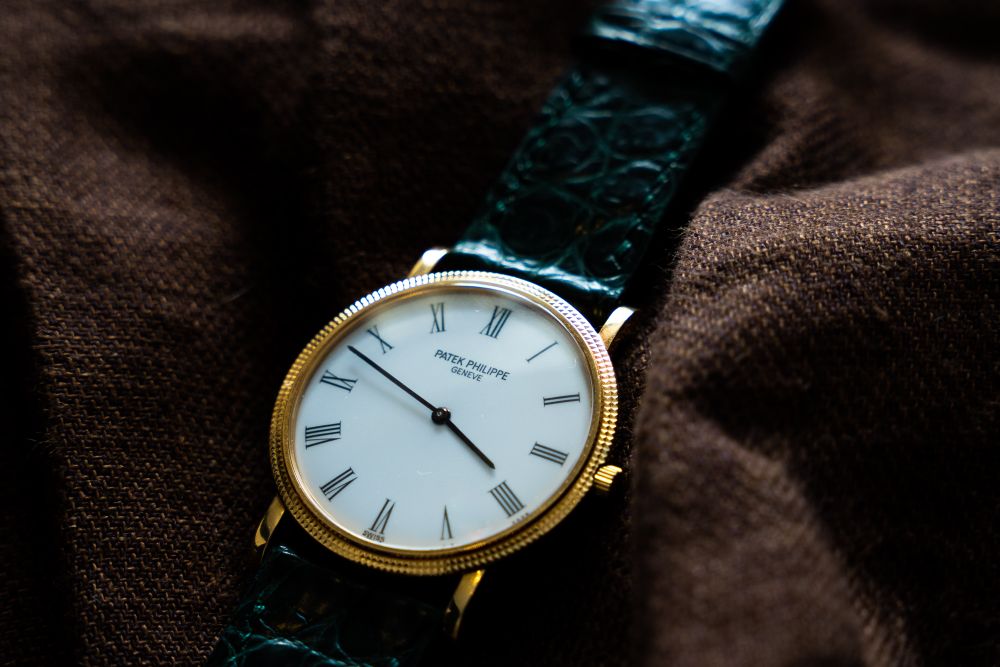
Patek Philippe’s Calatrava gives us an almost perfect counterexample. Browse different generations of pre-owned Patek Philippe watches and you can watch men’s sizing preferences change while the basic design remains remarkably coherent.
The original Calatrava Ref. 96, introduced in 1932, measured roughly 31mm. By current standards that sounds tiny for a men’s watch, particularly to anyone whose collection consists mostly of modern sports models. Its slim bezel, straightforward dial, slender lugs, and restrained case give those 31mm more presence than the raw number might suggest.
Move forward to the Ref. 5196 and the case grows to approximately 37mm. That size works beautifully for many modern wrists because it retains the restraint expected of a dress watch while providing a little more visual weight. The newer Ref. 6119 reaches 39mm and adds a Clous de Paris bezel, giving the Calatrava considerably more character around the dial without abandoning its dress-watch proportions.
The secondary market becomes especially interesting here because you can choose among decades of Patek sizing rather than accepting whatever happens to be current. A tall man who prefers a subtle watch may adore the 5196. Someone shorter with a broad wrist might prefer the 6119. Neither has violated any known law of horology.
Geometry Changes Everything
The Audemars Piguet Royal Oak makes diameter comparisons even more entertaining. The classic Royal Oak “Jumbo” occupies the much-loved 39mm category, which sounds fairly restrained beside the 41mm and 42mm sports watches common today.
Then you put one on…
Its octagonal case, broad bezel, integrated bracelet, and angular geometry spread the design across the wrist in a way a conventional 39mm round watch does not. The bracelet begins contributing to the overall shape immediately, while the relatively thin profile prevents all that width from becoming cumbersome.
This is one reason the 39mm Royal Oak has remained such an admired proportion. It has presence without relying on case thickness or an enormous diameter to create it. Comparing it to a 39mm Calatrava based solely on the number stamped on a specification sheet misses almost everything interesting about either watch. Even better, second hand Audemars Piguet watches are plentiful via reputable third-party resellers, and you can even get the box and papers.
Tall Men Can Wear Small Watches
The idea that tall men automatically need large watches becomes especially strange once you look at vintage photographs. Men considerably larger than the average modern watch collector spent decades wearing 34mm, 35mm, and 36mm watches without anybody rushing over to offer them something bigger.
A smaller watch can look exceptionally good on a larger wrist, particularly when the rest of the person’s style is restrained. There is a deliberate quality to wearing a vintage 34mm dress watch when you could comfortably accommodate 42mm. The watch becomes a detail rather than the centerpiece of the outfit.
The reverse can also work. A shorter man can wear a relatively large watch when his wrist provides enough room and the case geometry cooperates. Lug overhang, excessive thickness, or an uncomfortable bracelet will cause problems long before a driver’s license reveals how tall the owner is.
Trust the Mirror
When choosing a watch, start with your wrist measurement and then look at the complete design. Check the lug-to-lug dimension, case thickness, bracelet or strap, bezel proportions, and the amount of dial that is actually visible. Those details will tell you considerably more than height alone.
It is also worth looking at the watch in a mirror. Staring directly down at your wrist from a few inches away exaggerates its size, and phone photographs can introduce even more distortion. Seeing yourself from a normal distance gives you a better idea of how the watch relates to your hands, arms, clothing, and overall build.
Height can remain part of the conversation, especially at the extremes, but there is no formula requiring a six-footer to wear 41mm or sentencing a shorter man to the 36mm cabinet.
If the watch sits properly, looks proportionate, and makes you want to keep checking your wrist when you already know perfectly well what time it is, you’ve probably found the right size.