
The choice between a wearable and a freestanding pump is usually framed as a choice between freedom and power, and that framing helps nobody. Both types empty a breast, both fit in a bag, and both have a place in the same week. What actually separates them is the shape of the day they have to fit into: how many sessions, where they happen, who else is in the room, and how much milk each one needs to produce. Start with the day and the machine usually chooses itself, because this is a question about logistics rather than about suction curves.

What a Pumping Day Looks Like
Feeds, Work and the Gaps Between Them
Most people choose a breast pump by reading a specification table, then discover that the table says nothing about a nine o’clock meeting. Count the realistic sessions first. A day at home with a newborn may need eight, spaced two to three hours apart, while a day in an office may allow three, and the gaps between them decide how much milk each session must collect. Write those numbers down before looking at any product, because the count rules out half the market immediately. If the count is six or more, a machine that needs a table and a socket will become a source of friction, however good its motor is.
Where Pumping Happens
The room matters as much as the schedule. A bedroom with a door that locks, a sofa and a free socket allows a freestanding pump to work at full strength. A train, a shared office or the back of a car allows something else entirely. Ask where the session will happen on the worst day of the week, not the best one, because that is the day the equipment has to cope with. A pump that only works in ideal conditions ends up unused. A shared fridge, a glass door and a corridor with foot traffic are all part of the answer, not decoration. A door that locks beats a good motor on most days.
What Each Type Asks of You
Wearable Pumps and Hands-Free Movement
A wearable pump sits inside a bra, collects into a small cup and lets you keep doing whatever you were doing. That is genuinely useful during a commute or while supervising a toddler. The trade is capacity and suction: cups hold less than a bottle, and a full cup has to be emptied before the session ends. Wearables also ask more of your clothing and your confidence, since the shape is visible under thin fabric and the motor hums at a pitch colleagues can hear. None of that is a reason to avoid them; it is a reason to plan the outfit and the timing. Choose a top that hides the shape and the rest follows.
Freestanding Pumps and Higher Output
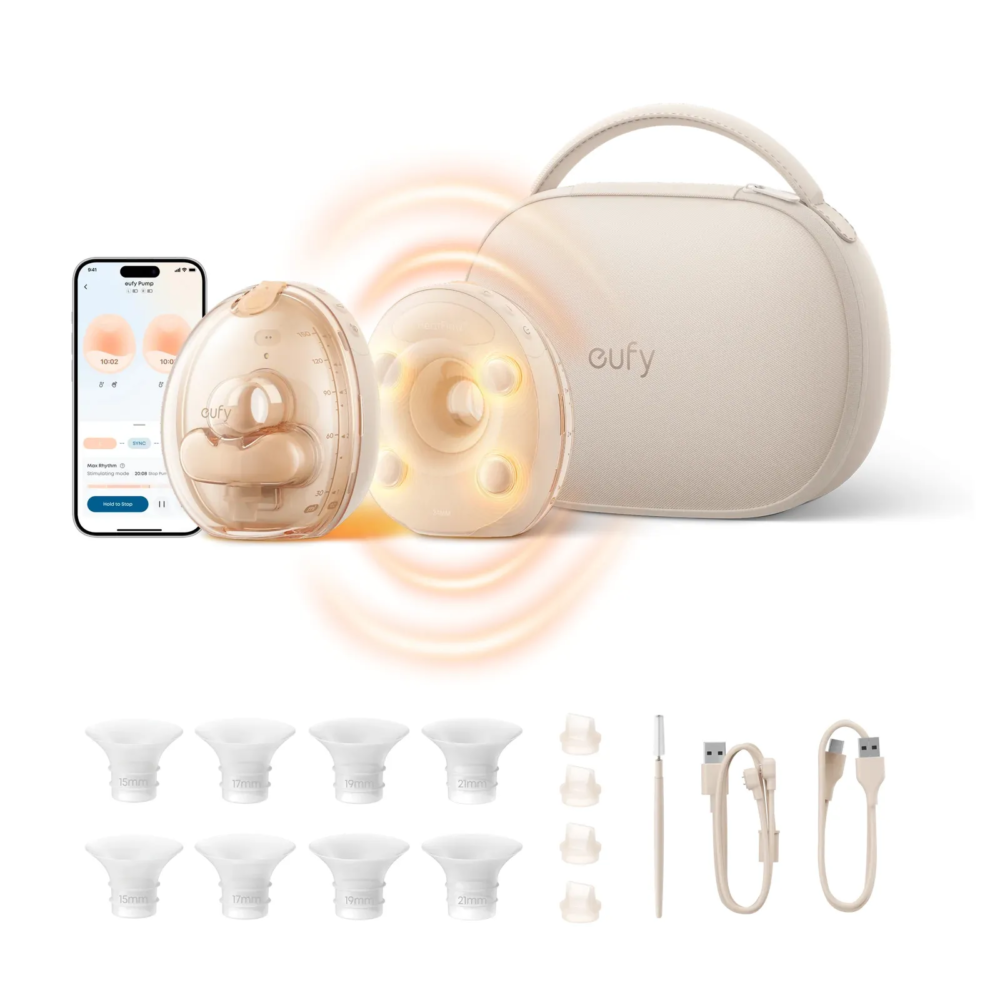
A freestanding pump has a motor on a table, tubing and a bottle, which is more to carry but also more to work with. Suction is stronger and steadier, sessions are usually shorter, and the bottles hold enough for a full feed. Portability has closed much of that gap: the eufy S2 Pro carries that strength in a body that goes in a bag rather than on a desk, with no tubing to route and no socket to find, and a VibraPump massage runs alongside suction to encourage let-down, so a session finishes 30% faster than a plain cycle at 46 dB, quiet enough to use in the next room. What remains is habit, since a full bottle still has to be carried home. The machine no longer decides where you pump.
Matching the Pump to the Stage
The Early Weeks and Establishing Supply
In the first weeks, frequency and effective emptying matter more than convenience, and a machine that stays in one place is simply easier to lean on than one that travels. Supply is being set by how often and how completely the breast is drained, so a session that leaves milk behind works against you. Most families are better served by a strong pump at this stage, used somewhere comfortable, with a second one added later as a supplement rather than as the main tool. Judging a pump on one difficult week is how good machines end up in a cupboard, and that season passes faster than the equipment lasts. Patience with the boring middle matters more than any feature on the box.
Later Months and Returning to Work
Once supply is established, the balance shifts. Sessions become fewer and the priority moves to fitting them into a working day, which is where a wearable earns its keep. Many households end up with both: a freestanding pump for mornings and evenings at home, and a wearable for the office or the school run. Buying one and then the other is not indecision; it is matching equipment to a routine that changes faster than any product cycle. Keep the spare parts compatible, too, so that a missing valve does not end a session, and a second set of flanges buys more usable time than a second motor. The routine, rather than the pump, decides which of the two leaves the house on any given day.
Conclusion
Neither type is better in the abstract. The wearable buys movement and asks for smaller volumes and a little audacity; the freestanding buys output and asks for a room, a socket and ten quiet minutes. Decide how many sessions the week really contains and where they will happen, then choose the machine that survives that answer. Most people discover they need a different pump in month one than they do in month six, and that is normal rather than a mistake. The equipment follows the routine, never the other way round.