Full Spectrum Affection
The BFI London Film Festival is genuinely one of my highlights of the year, every year. With an incredibly broad mix of storytelling in a multitude of forms, from a myriad of countries and the ability to recognise pretty much all tastes. There may be elements that don’t really do anything for you, and then there are works that tick every single one of your boxes possible, then invent entire new strata of boxes, only to immediately and joyfully check all them too.
Sashay forward with an exuberant and radiant smile… The Extraordinary Miss Flower.
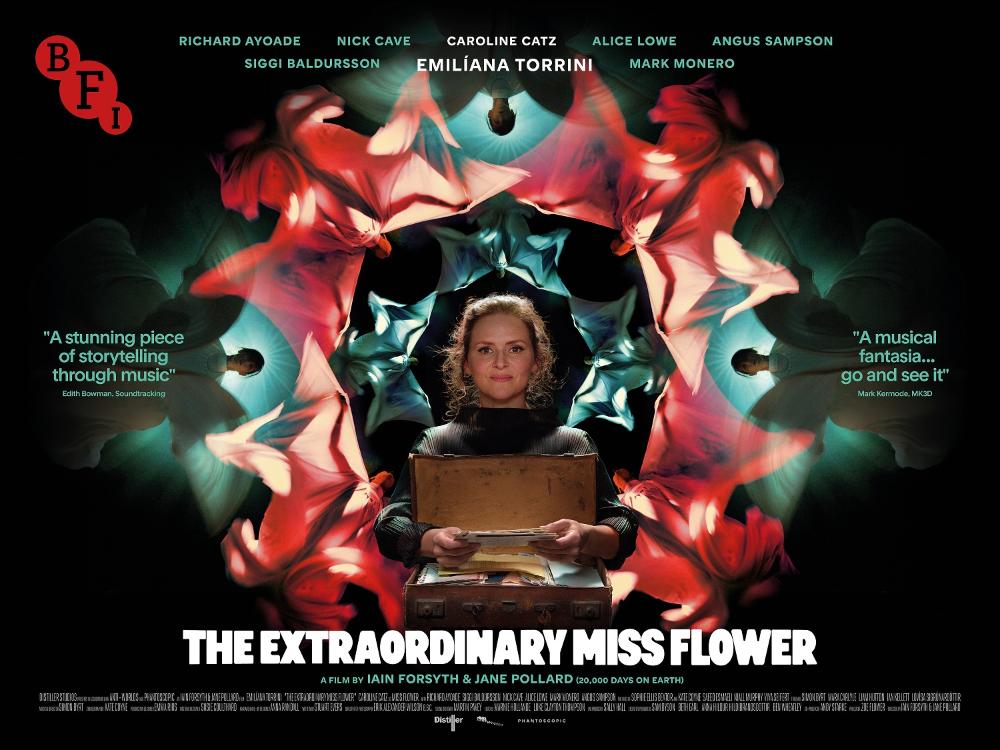
I first became aware of what is ultimately an ongoing, and constantly evolving project of unfettered love, for an individual, and for life itself, when Flush covered the genesis of it all in our review of Emilana Torrini’s album Miss Flower (reviewed here). An ethereally beautiful and mesmerising homage to an equally hypnotic person, the album, as it transpires, was just a mere tantalising, and intoxicating taste of what was to come.
It was through researching the background to the album that I learned of the forthcoming adaption, or more realistically the jubilant creative explosion that is the performance film ‘The Extraordinary Miss Flower’ directed by Iain Forsyth and Jane Pollard, the very folk who brought us the outstanding ‘20,000 Days on Earth’ (2014), a film about the life thus far of one Nick Cave.
In every way imaginable, and as gorgeous as the album is, it really was just the seed, that has now been lovingly nurtured into the musical equivalent of Kew Gardens, such is the radiant colour, joy, life and warmth that emanates from every single second of the film. To say they embraced the title is an understatement, but ‘Extraordinary’ is absolutely deserved across the board, from artists, musicians, lyrics, performances, writing, lighting, sets, sound, cinematography, editing and of course direction.
The highly contagious celebratory nature of it all feels more like a spontaneous jam session, an exuberant care-free flow state with a giddy sense of a ‘For One Night Only’ performance, where everyone involved gives everything they have in honour of the story and inspiration. It has a wonderful sense of slightly controlled, gently steered chaos, playfully trying to capture something that can’t actually be contained, only providing fleeting spectacular glimpses, hinting at the most amazing thing we all get to share, all too briefly, life itself.
There’s a jovial glee to the seemingly loose editing, bouncing between beautifully grounded shots of musicians smiling at each other when they realise they have successfully given their all, to intertwined audio, conversations, visuals, set pieces, choreography and performances, all layered upon each other, reminiscent of sifting through the case of discovered photos and letters that were the very catalyst for the entire project.
To portray such freedom of course demands profound skill, by individuals at the top of their game, and in symbiosis with everything around them. I have no knowledge of how long the shoot was, or how many takes etc were done, but it absolutely feels as free-spirited, honest, unbridled and as intoxicating an experience as it must have been to be sitting in a cafe with Geraldine Flower herself.

Said cafe is a running visual thread throughout the film, staged both in style of set and film stock of the 1970s, as the story intermittently unfolds of Geraldine’s genuinely extraordinary life and escapades. Through playful endearing, meandering chats between Miss Flower (Caroline Catz) and Emilíana, in addition to truly hysterical renditions of her letters read by guests including Alice Lowe and Nick Cave amongst many others, there is some gob smacking and life enhancing outrageously funny moments as the inner thinking’s of former forlorn, besotted suitors become the eternal musings of pining poets.
Suffice to say, if all this was randomly written as a script for a film, it would be deemed ridiculous, which only adds to the wanton celebration of it seeming too ludicrous to be true, yet here is life giving a knowing cheeky wink right back at us.
Each track from the album expands like the universe itself into ever increasingly beautiful moments of story, performance and creativity, with individual treatments to enhance their diverse nature and tone. These radiant flourishes utilise somewhat simplistic stage tricks with incredibly captivating, and at times psychedelic results, as each track becomes even more hypnotic and mesmerising than the previous, it is a genuine and loving splendour to behold.
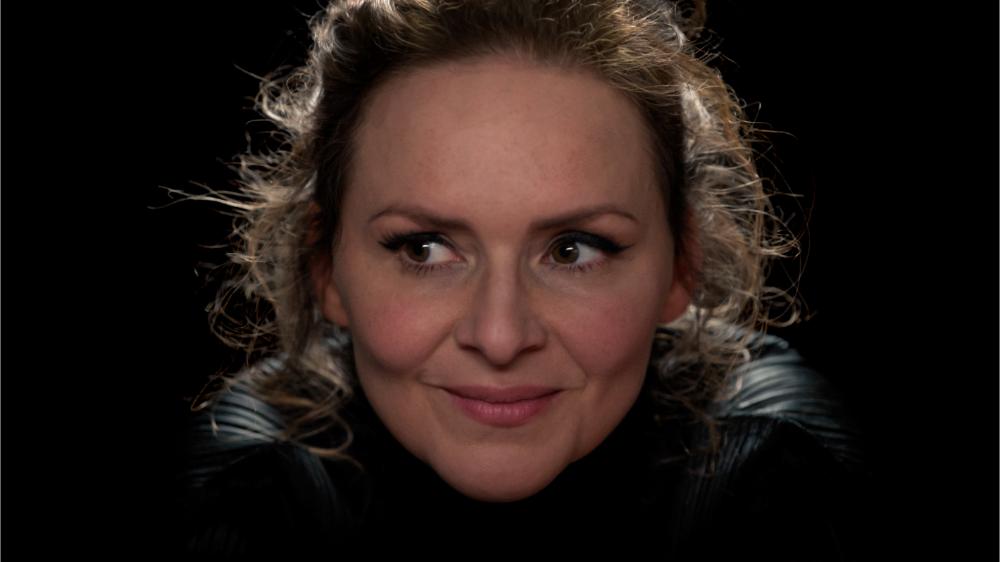
Again, as mentioned previously, the album Miss Flower is beautiful in itself, but the expansion of song, story and medium into The Extraordinary, is like Dorthy stepping into Technicolor Oz. Hearing the tracks on a cinema sound system equally carries the same dramatic response, as the surrounds, embraces and warms you to your very core. Emilíana’s voice was already stunning, but now…
Years ago Professor George Land developed a test for NASA to source creative thinkers for the space program. Through his research he discovered that at the age of 5, 98% of the kids where inherently very creative, by the age of 15 it was 12%, finally adults at 2%. It was apparent that ‘non-creative behaviour is learned’, people actively suppress it.
The Extraordinary Miss Flower is a lighthouse beacon warding us away from such diminished existences. It is a celebration of a life force, and the lives she shone her light on, in turn nurturing others and creativity itself, the further her rays shine over time. If it all sounds somewhat romantic, that’s because it is. The film is to its very core about love, and how that tenderness can inspire entire lives, continuing to shine on well after the star has faded.
It’s also an incredible and beautifully fitting homage to a mother. We often ‘honour’ departed individuals with static, soulless stone, or brass carvings, plaques, meaningless objects devoid of warmth or celebration. This film, album and stories like it is how to truly honour a life, by being actively inspired by it, creating, sharing, enhancing and bringing smiles, love, unity and joy to all around us.
If the film doesn’t do that for you, bare minimum I hope it gets people back into writing letters… my, the stories one could, and should tell.
Incidentally, Emilíana has just released a Miss Flower (Remixes) EP, of course they are beautiful.
10/10 – Interview below added 7th May 2025.
Q&A with Iain Forsyth & Jane Pollard For Flush The Fashion
1. You came to the project after some of the songs had been written, but the album hadn’t been finished, it was still evolving. That enabled you to have an initial filtering of the treasure trove via Emilíana, honing in on particular aspects such as the drama, stories and period. It still allowed a collective growth in how it would be visualised. How quickly did these visuals, treatments appear? Did any arrive fully formed, or indeed were they difficult to find a suitable treatment?
Although we were already talking about the project, we didn’t hear any of the songs until the album was close to completion. As soon as we did, the ideas started to play out in our minds. We believe in working on instinct rather than overanalysing at the outset — creating an open space for ideas to breathe. Years of collaboration have given us a kind of creative shorthand with each other, and we quickly built a similar trust and rhythm with Emilíana, Simon, and Zoe. Ideas formed fast, some arriving almost fully shaped, while others needed careful teasing out, but everything evolved organically from that shared trust.
2. At what stage did the title of the film come into being? It quite rightly lands as a sort of manifesto of Geraldine’s approach to life.
Titles are strange beats. Sometimes they arrive in a heartbeat, fully formed. Other times they’re elusive little beasts. This one came easy. Geraldine’s life, filtered through Emilíana’s imagination, took on a playful, ’70s-fairy-tale magic. The title captured that spirit perfectly — a manifesto for living boldly, just as Geraldine did.
3. You’ve spoken about influences on the film such as Stop Making Sense, The Strange World of Gurney Slade (which I’ve started watching and it is incredible). I also felt echoes of films from the period of Roeg’s Performance, Jodorowsky’s The Holy Mountain, The Monkees Head, Jean-Luc Godard’s Pierrot le Fou, more contemporary works such as Caro & Jeunet’s Delicatessen, Gondry’s Be Kind Rewind, and given the catalyst for the entire project, a Chris Morris edition of Points of View (BBC TV show where viewers letters are read out). Truly refreshingly, there seemed to be no boundaries to the creative visual exploration, aptly of a person who seemed to not acknowledge oppressive societal boundaries. What was the process in discovering and forming the treatments?
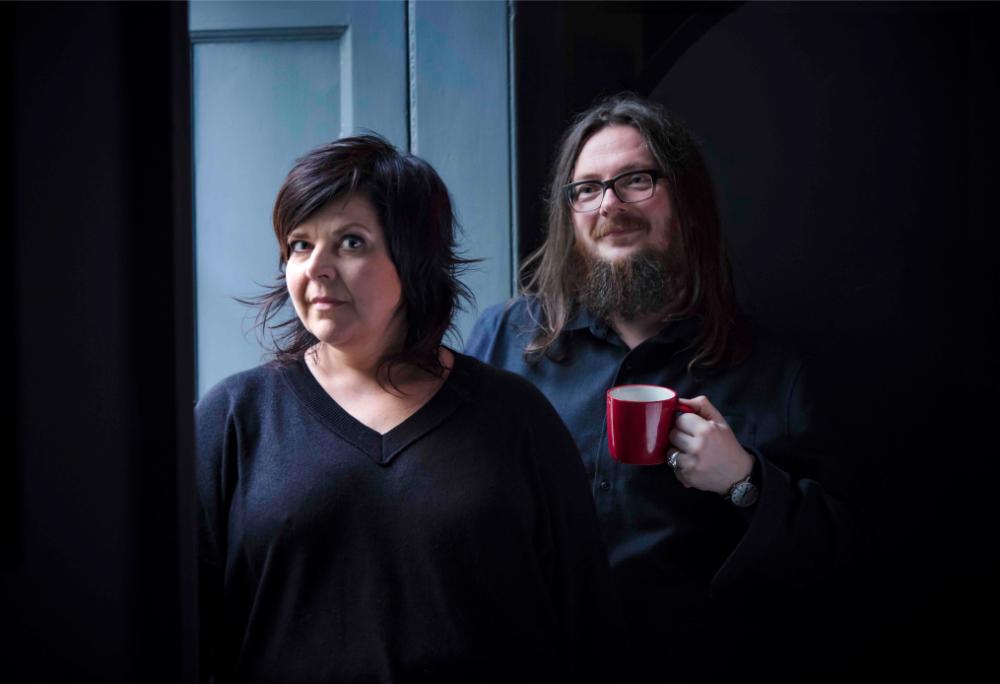
Our approach developed over thirty years of working together, so it’s difficult to analyse too much. Broadly, we envisioned each performance like concentric circles, always keeping Geraldine and Emilíana at the core. The narrative sequences gave the film its backbone, while the visuals blossomed outward from the music itself. Often we’d rework arrangements with Simon to better suit an on-screen experience — bringing vocals in earlier, for example. Some of our constant influences like O Lucky Man! provided a touchstone, especially in how music weaves directly into story. The way the band, led by Alan Price, act as a greek chorus, appearing in the film at the same time as providing the score for it is just incredible. And yes, The Strange World of Gurney Slade emboldened us — it gave permission to play a little further outside the lines.
4. Given the admirable free spirit of Miss Flower, her energy feels like a pagan defiance of the restrictive rules at the time (or even now), especially of gender. The dancing and highly contagious overt, almost sensual joy in the film feel like ritual dancing in pagan ceremonies, at one with life, evoking and celebrating our transient experience of it. Even the recording of the footage in just two days reflects the temporary nature of everything, and embracing it. Living in the moment, for that moment. Was this deliberate, or a naturally emerging display of Geraldine’s energy?
It was both deliberate and intuitive. Limited time and resources forced us to adopt a fast, instinctive approach — and we embraced that. Musicians aren’t used to the endless waiting of film sets, and this immediacy suited Geraldine’s own spirit. We wanted the making of the film to mirror Geraldine’s philosophy: seize the moment, live fully, celebrate impermanence. If that energy radiates from the screen, we’re very happy with that.
5. The choreography by Kate Coyne also evokes the seemingly timeless dream space memories inhabit. How early in the process was she able to come on board and begin to experiment with and explore the themes that were coming out of the project? What was that collaboration process like, especially when working with the infinite possibilities of physical expression?
Being able to work with Kate was a dream. We’d met her a few years ago when she was running the Michael Clark Company, and have wanted to work with her ever since. Serendipity struck when we discovered that Kate and Zoe already knew each other. Although time was tight, Kate immediately grasped the film’s themes and collaborated intuitively with Emilíana and the dancers. Her ability to conjure profound emotional expression through movement, even with limited prep time, was remarkable. She brought a vital layer of physicality to the project.
6. The use of in-camera effects (by cinematographer Erik Wilson), lenses, back projections, and theatre or stage effects not only captures a beautiful, magical, surreal and unique world, much like Geraldine herself, it also echoes iconic and visually stunning films that I’ve previously mentioned, and most importantly, does so in an analogue context. An organic, orgasmic, psychedelic celebration of colour, shapes, movement, sound, perceptual distortion, a living, breathing and dancing entity conjured from the letters as if they were incantations. Not only does it feel completely apt, but it is defiantly original, again like Miss Flower herself. Was this a conscious decision, or part of the natural evolution?
Doing everything in-camera was non-negotiable for us. We love working like this, and it’s a passion we share with Erik. We’ve done quite a lot together now and we all enjoy the hands-on creativity that comes from having to make things happen in the room.
That’s something else that’s come from working so much with musicians. We used to direct a lot of live music sessions for record labels like 4AD, Rough Trade and Mute. Most bands feed off the energy in the room and what’s directly in front of them. So that’s what we like to focus our energy on.
Doing it all in-camera was non-negotiable. It’s how we — and Erik Wilson — love to work: solving problems creatively in the moment. Our background directing live sessions for bands taught us that the best energy comes from what’s happening in real time, in front of your eyes. That immediacy is infectious, and it felt especially important here — to create something that felt alive, breathing, slightly unpredictable, just like Geraldine herself.
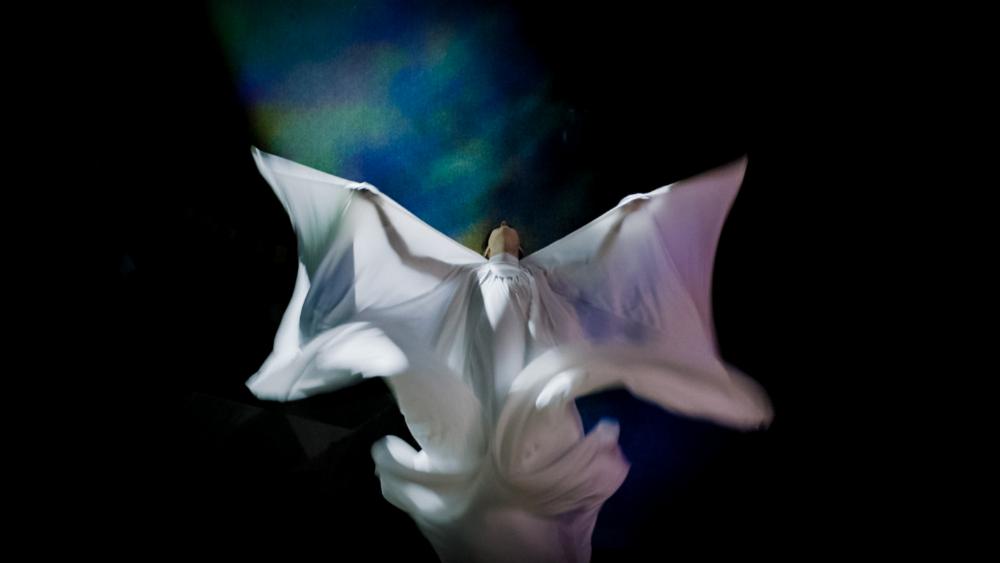
7. Continuing that sense of play, celebration and dancing with imagery and movement, it feels like it’s actively not defining, but evoking a dream-like liminal space, time travelling to universal emotional response destinations, almost as if they are the addresses for the letters themselves. This seeming lack of focus only enhances the sensations and experience of the songs. How difficult was this process, as it feels like alchemy.
We consciously chose a playful, dreamlike approach to storytelling, in keeping with the spirit of Emilíana’s songwriting. Instead of following a strict timeline, we allowed characters to drift through time and space. The film became less about tracing events and more about capturing a feeling — an emotional memory rather than a biography. Like dreams, it’s fluid and strange rather than tethered to the real world.
8. The letters are effectively gateways, or departure points to what could be entire novels, films, or dimensions in their own right. Given the staggering amount of creative exploration already going on, were there times when the desire to shoot into other space creatively, had to be harnessed and brought back to fit time constraints? How much was pre-planned, and how much was improvisation on the days?
Necessity is the mother of invention, the saying goes. Pragmatism shaped a lot of our creative decisions. We knew from the start what time and budget constraints we faced, and we structured accordingly — a single, self-contained space. With the letter writers/readers, we didn’t want their worlds to become too literal or grounded, so these were shot separately. We asked our art director Emma to create these deliberately hand-rendered spaces that would be familiar yet strange at the same time. We wanted to keep everything feeling unified but dreamlike. Although the overall plan was tight, we always like to keep space for improvisation, especially for Emilíana, allowing her performances to stay spontaneous and real.
9. Given the nature of the film, the sound production is an integral element to the entire experience. While the sound on the original album is fantastic, the expansive 360º sound in a cinema setting is truly transformative, not only in ethereal vocals, but also the band warmly embracing the audience, sound effects warping reality, as we continue on this magical exploration. What was the process behind the mixing of the sound?
Sound is so important to us, but the nature of the project meant it was always going to be a major character in the film.
We were lucky to be able to shoot at Distillery II in Bristol, which is a world-class recording studio, and with an excellent team overseeing capturing everything. Simon, who recorded and co-wrote the album with Emilíana, mixed the music and the film sound was mixed by the incredible Martin Pavey. He’s probably best known for his work with Ben Wheatley, but has worked with lots of great filmmakers including Alice Lowe, Peter Strickland and Brandon Cronenberg, so he knows a thing or two about sound! He helped us to craft an immersive soundscape that we hope wraps the audience inside Emilíana’s imagination and Geraldine’s magical world.
The Extraordinary Miss Flower is out via BFI on 9 May, for screening information (including Q&A screenings click here.
For more information on the film check here. Emilíana Torrini Miss Flower (2024) is out now via Groënland Records. More information can be found at emilianatorrini.com