
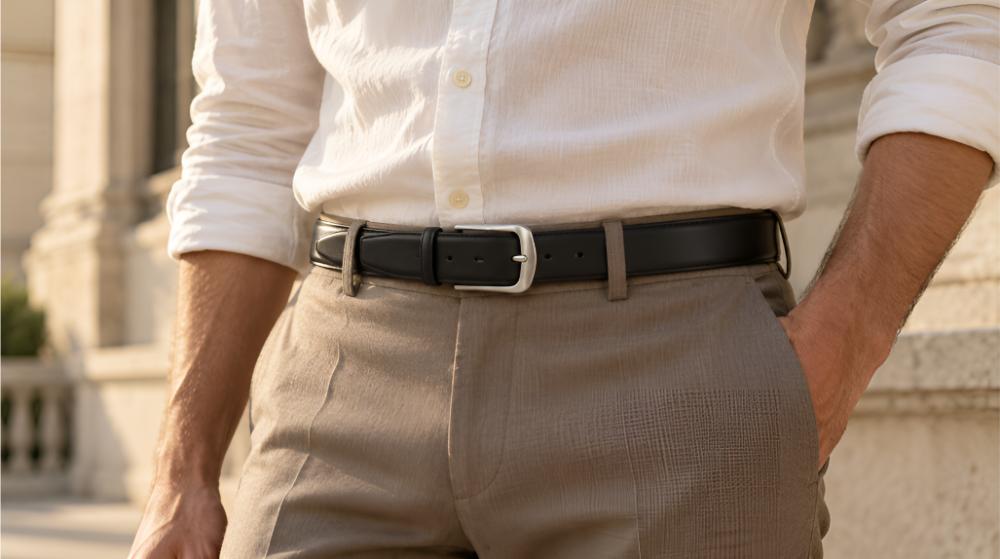
A belt is one of the hardest-working pieces in a man’s wardrobe. It bends every time you sit, carries tension throughout the day and is often worn several times a week. A polished surface may attract attention in the shop, but longevity depends on what sits beneath that surface and how every component has been put together.
For anyone choosing a belt intended to last beyond a season, these are the details worth examining.
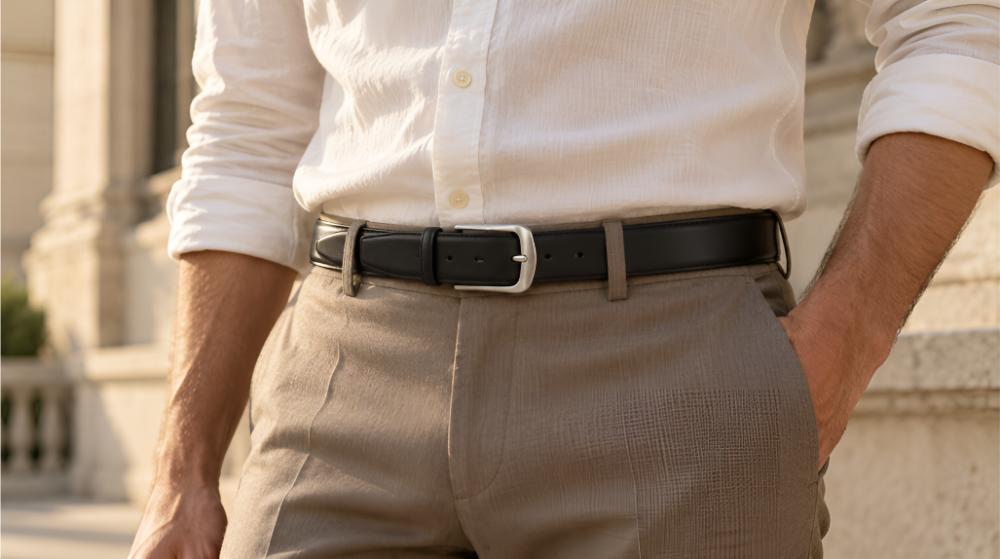
Begin with the structure beneath the finish
Two belts can look almost identical when new and behave very differently after months of wear. The reason is often their internal structure. A thin decorative coating applied to a weak backing may crease, separate or peel where the belt flexes most. A stronger composite construction distributes that movement more effectively.
This is especially relevant when comparing vegan materials. The term vegan describes what a material does not contain; it does not, by itself, describe quality. Some inexpensive belts use a basic coated fabric, while higher-performance options use a dense microfiber base combined with polyurethane. The fine fibres form a supporting structure that helps the material recover its shape after flexing. In practical terms, the backing helps the strap cope with repeated bending and tension rather than relying on the surface coating alone. For more detail, see research on microfiber synthetic leather.
Brands that publish meaningful material details make comparison easier. Doshi, for example, uses microfiber-backed materials across many of its men’s vegan belts, pairing the belt strap with carefully selected hardware rather than treating “vegan” as the only specification that matters.
Look closely at the flex points
The section around the most frequently used hole usually reveals a belt’s weaknesses first. This area is repeatedly pulled, folded and released. Before buying, bend the strap gently rather than judging it only while it lies flat. The surface should move with the body of the belt instead of looking brittle or immediately forming sharp white stress lines.
Thickness alone is not proof of durability. An overly rigid belt may resist movement at first but concentrate stress around the holes and buckle fold. A very soft belt may feel comfortable yet stretch out of shape. The better sign is controlled flexibility: enough structure to hold its line, with enough resilience to move naturally.
Edges and stitching reveal the standard of construction
Edges are easy to overlook, but they are exposed to friction every time the belt passes through a trouser loop. Check that they are smooth, even and consistently finished. Rough sections, visible gaps between layers or excessive adhesive can indicate that the belt may begin separating under regular use.
Stitching should be straight and balanced, particularly near the buckle and keeper, where the greatest strain occurs. More stitching is not automatically better; accuracy matters more than decoration. Uneven tension, loose threads and stitches placed too close to the edge can create weak points rather than reinforce the strap.
The buckle deserves a closer look
Hardware affects both appearance and service life. Zinc alloys are widely used because they can be cast efficiently into detailed shapes. Their performance, however, depends on the specific alloy, the casting quality and the surface finish. Stainless steel generally offers greater inherent corrosion resistance because chromium in the alloy forms a thin protective passive layer, as explained by World Stainless. That makes it a strong choice for a buckle handled daily and exposed to moisture, skin oils and changing weather.
Weight can offer a clue, but it is not a reliable test on its own. Ask what the buckle is actually made from. Clear specifications such as stainless steel are more useful than vague descriptions like premium metal or luxury hardware.
A good finish must survive contact
Black, gunmetal and gold-tone buckles typically get their colour from a surface treatment. Electroplating is common, but coating quality and thickness vary considerably. Physical vapour deposition, usually shortened to PVD, is another method used to apply a thin coating. The method alone does not guarantee a durable finish: the coating material, application quality and underlying metal all matter.
No coloured finish is completely immune to abrasion, especially where a buckle rubs repeatedly against a desk or countertop. Still, knowing both the base metal and finishing process gives a more realistic indication of how the buckle may age.
Correct fit reduces unnecessary strain
Even a well-constructed belt can be put under unnecessary strain if it is consistently pulled too tight. Choose a size that closes comfortably, ideally near the middle of its adjustment range. That leaves room to adjust for different trousers or changes in fit without needing extra holes.
Width matters too. A wider, more substantial belt often suits jeans, while a slimmer belt generally works well with tailored trousers. Check that the strap passes comfortably through the loops and lies flat without bunching or twisting.
Simple care helps protect the materials
Store a belt hanging straight or loosely rolled, rather than sharply folded. If it becomes damp, let it dry naturally before wearing it again. Wipe away moisture with a soft cloth and avoid leaving it beside a radiator or inside a hot car, where prolonged heat can affect coated materials and adhesives.
Harsh cleaners are rarely necessary. If the manufacturer provides care instructions, follow them; material systems vary, and a treatment designed for animal leather may not suit a vegan alternative.
Ask better questions before buying
A lasting belt is not defined by one buzzword. It is the result of compatible materials, careful construction, appropriate hardware, a secure finish and the right fit. Before buying, look beyond colour and grain. Ask about the backing material, buckle composition, coating method, edge finish and sizing guidance.
Those details may not be as immediately visible as a logo, but they determine whether a belt remains a dependable part of the wardrobe or becomes another accessory that needs replacing.