
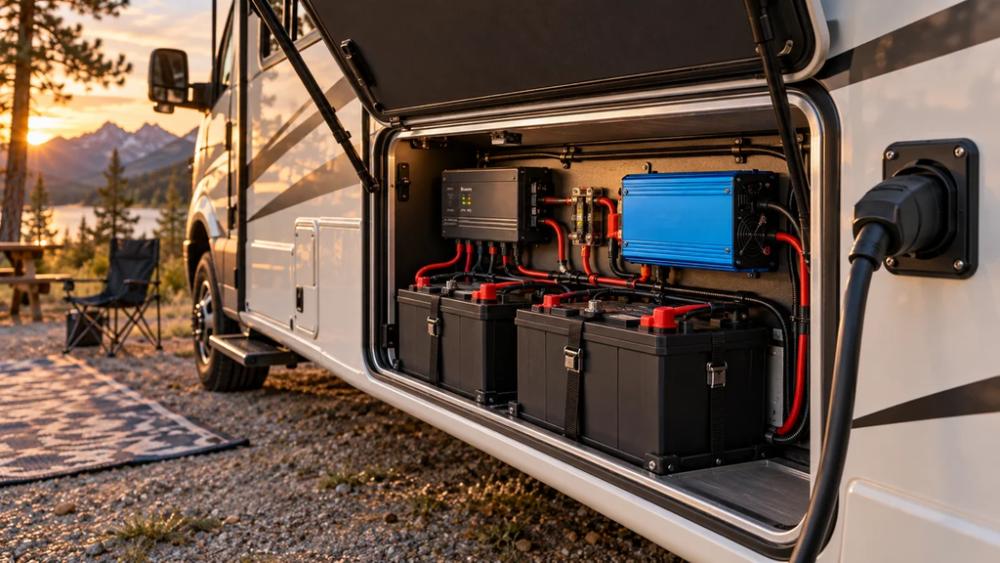
Running down a 12V battery is one of the most common mistakes UK campers and outdoor enthusiasts make. As the literal heart of your setup, this single power source keeps your lights on, your water pumping, and your heating running. It is also what keeps your food fresh and your cabin comfortable. By mastering simple battery maintenance and top-up routines, you won’t just prolong your battery’s lifespan—you’ll ensure your next getaway doesn’t come to an abrupt, freezing halt.
Off-Grid Charging Basics
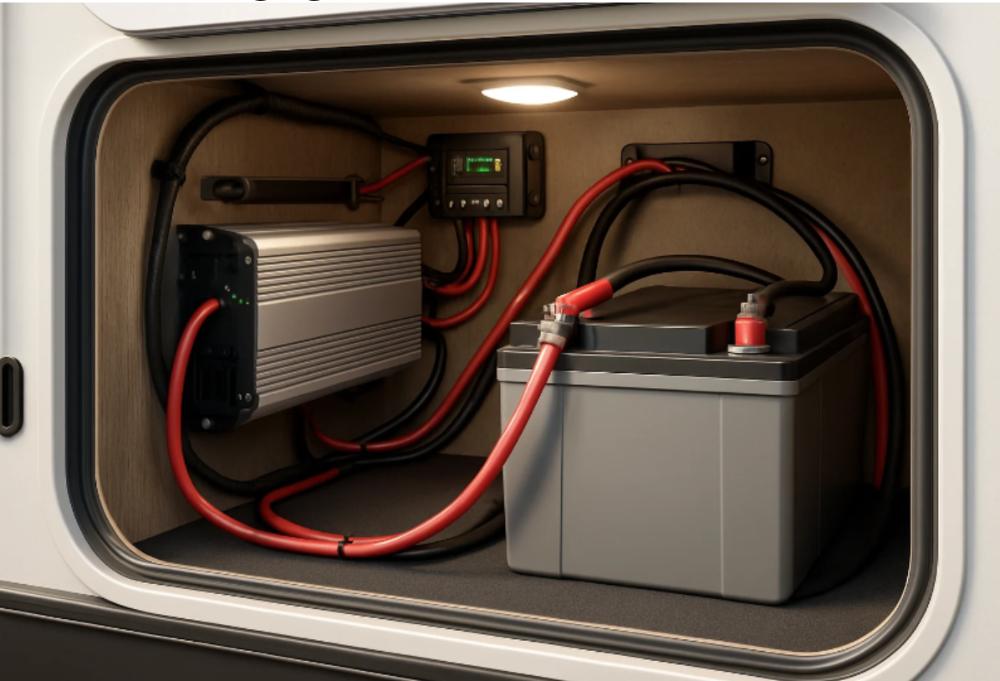
Campervans and motorhomes use two main types of batteries: starter batteries to crank the engine, and deep-cycle batteries to power interior appliances and lights.
Starter batteries provide a fast, high-amperage power burst to turn over the engine, relying on the vehicle’s alternator for charging while the engine runs. In contrast, deep-cycle batteries utilise thicker lead plates or lithium chemistries to deliver sustained, continuous power to run fridges, fans, and appliances.
These living-space batteries can be charged using properly connected DC-to-DC camper battery chargers hooked up to the vehicle’s alternator. Alternatively, and more frequently, they are powered by a dedicated AC-to-DC charger drawing shore power from a mains supply at campsites. For large motorhomes with a higher power draw—as well as outdoor enthusiasts on longer trips—this provides more flexibility, especially during bouts of bad weather or when using generators to keep the system healthy.
Why Battery Chargers Matter
A quality multi-stage battery charger keeps deep-cycle batteries healthy, efficient, and ready for use. Without the right charger, you risk overcharging, undercharging, or permanent damage that cuts battery life short.
Smart chargers adjust voltage and current through automatic bulk, absorption, and float stages to stop overheating. They also adapt to diverse power inputs—including solar panels, AC mains, and generators—to charge faster while reducing energy waste. Finally, they deliver a clean, stable current that protects sensitive onboard electronics and appliances from dangerous voltage spikes.
Charger Types
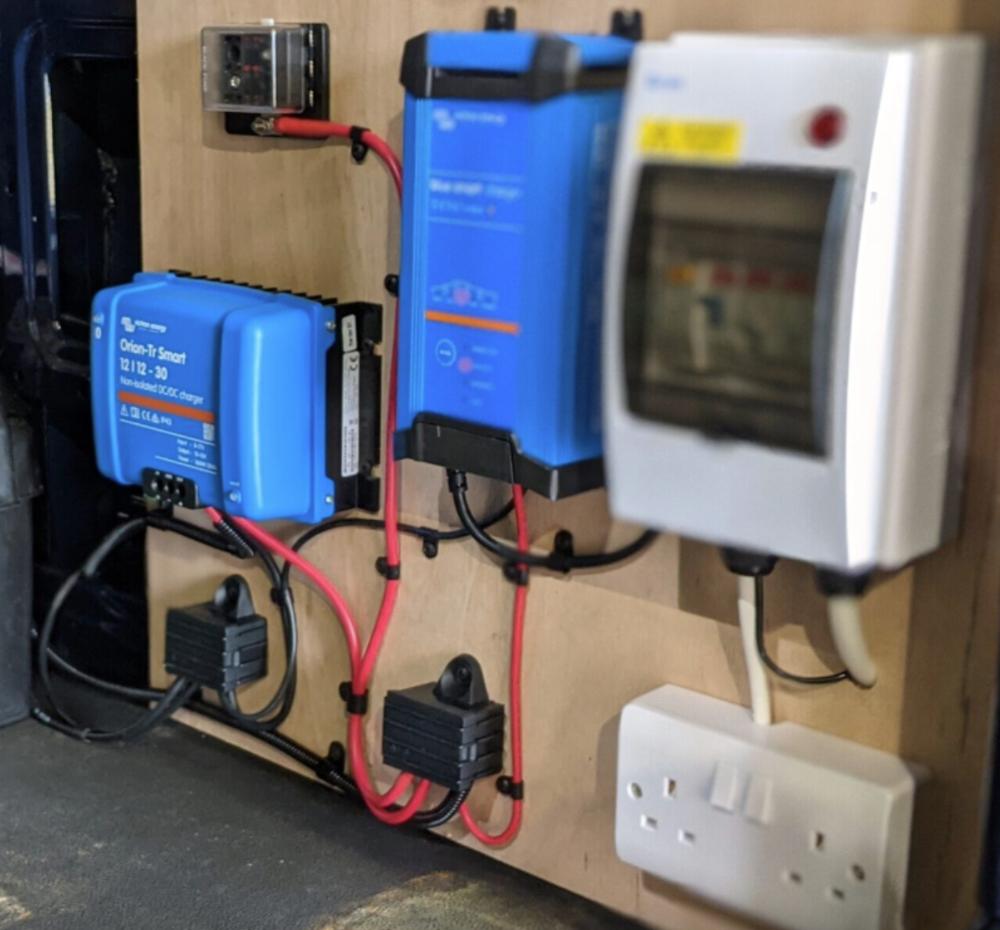
Camper battery chargers can be categorised by power source and charging methods into the following types:
- AC-DC 240V mains chargers: These plug into a standard campsite mains connection or a 230V wall socket to replenish your deep-cycle battery. They convert alternating current (AC) to usable 12V direct current (DC) using multi-stage charging without the risk of overcharging or boiling the battery cells. Options provide support for a wide variety of battery chemistries including AGM, Gel, Calcium, Lead-Acid, and Lithium (LiFePO4), often with user-selectable modes, as well as bulit-in and diagnostic features such as automatic battery recovery modes to revive deepy discharged or sulphated batteries.
- DC-DC & vehicle alternator chargers: These are designed to work with your vehicle’s alternator to charge your auxiliary batteries while you drive. DC-DC chargers ensure a steady, regulated charge from the vehicle’s electrical system, even with smart alternators common in most modern motorhomes, which might not provide a consistent charging voltage. A reliable DC-DC charger ensures safe charging, while safeguarding the vehicle’s alternator and electrical systems.
- Solar battery chargers: Solar chargers take energy generated by rooftop or portable solar panels and convert this into usable power for deep-cycle batteries. They use advanced technologies, such as Maximum Power Point Tracking (MPPT), to ensure batteries get the most efficient charge possible, even with unpredictable British weather.
- Hybrid chargers: These combine multiple technologies, including safe DC-DC charging (such as from the vehicle’s alternator); with integrated MPPT controllers to harness solar energy and inverters to replenish batteries from a shore connection or a connected generator. They benefit from compact designs that eliminate setup and wiring complexity, and provide flexible charging options, prioritising clean energy in good weather, or supplementing battery levels with alternator power when driving.
Mistakes to Avoid When Choosing the Right Motorhome Battery Charger
Choosing the wrong charger can lead to excessively long charging times, damaged batteries and wider off-grid power system issues. Avoid these common mistakes when selecting your next motorhome or campervan battery charger:
- Ignoring battery chemistries: Using a lead-acid charger on a lithium (LiFePO4) often results in undercharging, cell damage or overheating. Lead-acid chargers typically top out at around 13.2V to 13.6V, which will only charge a lithium battery to about 80% capacity rather than completely filling it. Some older lead-acid chargers also try to run an “equalisation” or desulfation mode with higher voltages, which can trigger the lithium battery’s protection system or cause damage.
- Mismatched voltage or sizing (amperage): Matching the system voltage (e.g., 12V vs. 24V) is critical. Connecting a 24V charger to a 12V battery will cause overvoltage, leading to gassing, melting or fire hazards. Similarly, connecting a 12V charger to a 24V system leads to virtually no charging action, or tripping or shorting of the charger’s internal electronics. Additionally, buying a charger with too low an amperage results in extremely long charging sessions, sometimes days, to fully charge batteries or larger battery banks. Alternatively, over-powered units can push too much amperage and cause batteries to sulphate, overheat, or even explode. As a general rule, choose a 10A to 20A charger for a 100Ah lead-acid battery (or 10 to 20 percent of rated capacity), and a 20 to 50A charger for lithium batteries for fast, yet safe charging times.
- Overlooking smart and maintenance features: Choose reasonably priced chargers with a full feature list. Basic and older units miss out on key features, such as automated switching to suit battery chemistries, true multi-stage charging and compatibility with your vehicle’s alternator. This means a flat, fixed voltage that ultimately damages batteries or leaves them half empty while driving. Moreover, the absence of basic safety features, including integrated temperature monitoring, cell balancing and auto shut-off, means a higher risk of overheating, gassing, or electrical fires.
- Mismatched wiring and voltage drop: Match chargers with wire gauges. Small-gauge cables or loose crimps cause dangerous voltage drops, heat buildup and tripped fuses.