
When we think of beautiful jewellery, we tend to think of all things shiny and sparkly – the deep hues of coloured gemstones; the irreplicable brilliance of a well-cut diamond. What we don’t do, though, is think about how such beauty is achieved. Those stones need to be held by something, and the manner in which they are held is far more important than it may seem to the untrained eye.
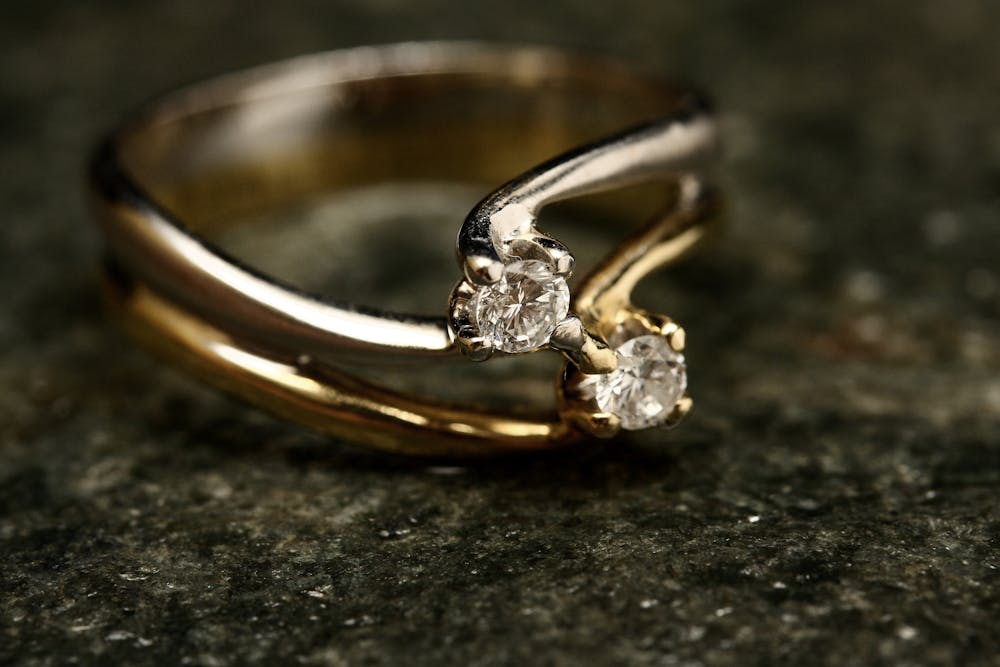
Welcome, then, to the art of ring settings. How jewels are set in a given item of jewellery – rings here as the predominant example – is immensely important, not just for the safety of the jewel in its place but also for the look of the finished product. Knowing your ring settings could well be the little kernel of knowledge you need to level up your jewellery collection! Let’s look at the three main settings used in rings: claw, bezel, and pavé.
Claw Setting
The claw setting, sometimes referred to as a prong setting (particularly on the other side of the pond, so to speak), is the least interventionist setting possible on a ring – by virtue of the simple nature of the mechanism at play. As it sounds, the claw is a pronged device that holds a diamond in place, just as your fingers might.
The claw setting is a popular choice for diamond rings, by virtue of its minimalist approach to displaying the stone. One could say it ‘gets out of the way’ of the diamond, allowing light to enter and pass through; with this, the diamond shines more brilliantly.
Bezel Setting
Bezel settings, sometimes called rub-over settings (again in the US), are settings that more tightly hold the gem in question, by virtue of lipping over the top of the gem on all sides. Bezel settings can be more or less intrusive as a design, but as a function of their design will always supersede all but the crown of the gem itself.
The benefit of the bezel setting is better gem security. Where a prong in a claw setting could break, allowing a diamond to fall out, the bezel holds the gem in place all the way round. The downside is a lessening of light accessing the gem, and potentially the addition of weight dependent on the size of the bezel itself. Still, bezel settings can be designed in a number of different ways, including partial bezel designs, to allow a gem to show its best – just a little more securely.
Pavé Setting
The pavé setting is one of the more complex arrangements for a ring, but when done well the results can be truly stunning. Pavé, of course, is the French for ‘pave’ – giving you a subtle clue as to the final look of a such a setting.
Pavé settings see multiple miniscule gems set closely and uniformly to one another around the band – resulting in the band seeming paved with brilliance. This is a particularly impactful effect where you have a larger centrepiece gem to show off, but can also be a beautiful way to create a low-ish profile ring that doesn’t show much if any of the core band. Beautiful as it can be, only buy pavé from a skilled jeweller; poor pavé means losing gems on a weekly basis!