
You can see the punch coming, yet you still won’t duck.
Do you know that feeling when you can see something coming from a very long way off and it hits you anyway? A birthday. A tax bill. The last episode of something you’ve been rationing. Behavioural scientists will tell you anticipation is most of the pleasure of anything.
What they tend to leave out is that it is also most of the pain, and Martin McDonagh has clearly read the same paper, because Wild Horse Nine tells you in its opening minutes exactly what sort of film it’s going to be – two CIA men, an island, one of them dying, a reckoning long overdue – and then spends two hours proving that knowing the punch is coming is no protection whatsoever.
I found this out at the Disney offices in Hammersmith, where the first order of business is the obligatory photo with Sully and Mike in the upstairs lobby: two monsters whose entire job is to frighten people and who famously can’t bring themselves to do it. Downstairs, McDonagh has no such trouble.
I went in expecting to laugh at things I shouldn’t and feel vaguely ashamed of myself on the Piccadilly line home, and I got that. What I didn’t expect was to be sucker-punched by a man I had no business caring about, and to explain how that happened, I need to tell you who he is.
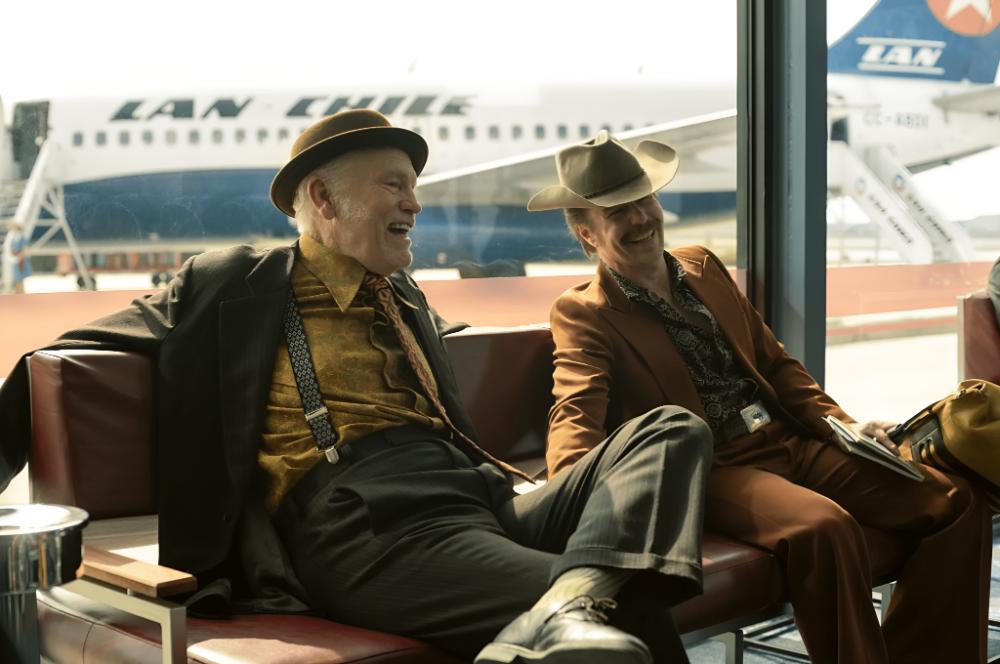
The set-up fits on a napkin. Chile, 1973, a few months before the coup America is busy arranging. Two operatives, Chris (John Malkovich) and Lee (Sam Rockwell), are packed off from Santiago to Rapa Nui, which you and I know as Easter Island, for a week’s leave. Chris is ill and knows it. He is also talking into a Dictaphone, morphine permitting, recording a career that includes a certain afternoon in Dallas in 1963, which is exactly the sort of memoir a bureau chief would rather didn’t exist. Steve Buscemi is that bureau chief.
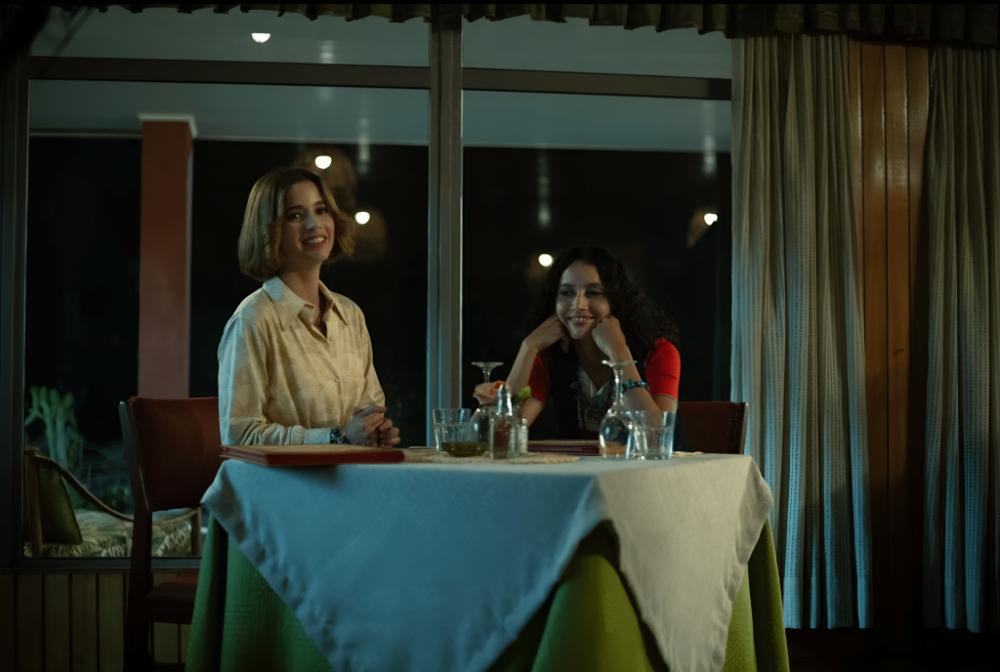
Lee has been sent along as friend, minder or something worse, and neither he nor we are sure which. Two Chilean students, Monica (Mariana di Girolamo) and Alicia (Ailín Salas), get chatting to the pair at the departures gate and end up tangled in the whole mess. If that sounds like In Bruges with a suntan, it is, a bit. So far, so familiar. You can see every piece on the board. What you can’t see is what’s going on inside Chris, and that is where McDonagh gets you.
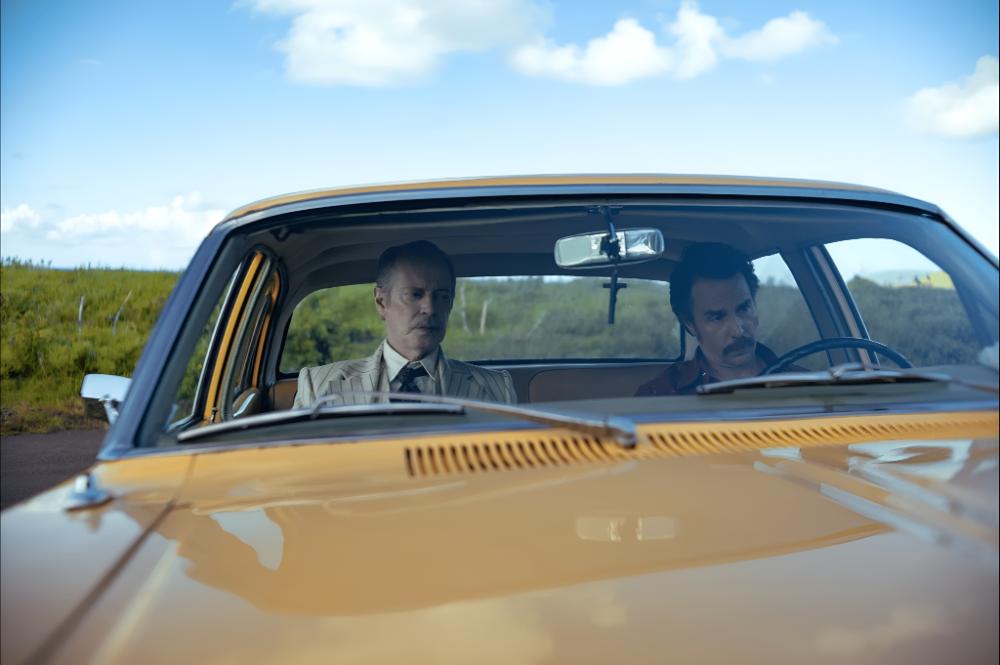
Because the question the film refuses to answer, and the one I was still chewing on days later, is this: has Chris lost it, or is this simply what it looks like when a man finally sits down with everything he’s done? He swings, scene to scene and sometimes line to line, between two people. One is the professional: clean, clipped, able to discuss a coup the way you’d discuss a boiler, who at the airport asks the students how they’re enjoying their nice new socialist president and all but confesses what he’s in the country for while Lee visibly dies beside him.
The other is a man who has started trying to save people. He tells Monica not to go back to Santiago, and means it more than anything he’s said in years. He cannot save himself, that ship sailed somewhere between Dallas and the morphine, so he spends what’s left trying to pull one stranger out of a fire he helped light, and you are never sure whether that’s conscience, or the illness, or both. There’s something Rory Sutherland would likely have a field day with in there too: a man recording a confession nobody will ever be allowed to hear, and it mattering to him enormously nonetheless. The logical value is zero. The actual value is the only thing he has left.
Malkovich plays all of that without ever once telling you which man you’re looking at. For the first twenty minutes I had him filed under seedy old chap with an unhealthy interest in girls half his age, and I was quite comfortable there, thank you. McDonagh lets you sit in that judgement until it curdles. The wit is sardonic and bone-dry, the kind that gets a room laughing at things that, said over dinner, would get you uninvited, and then he lets the light go out behind his eyes mid-sentence and you realise you’ve been laughing at a man drowning. He asks Lee for something no friend should ever be asked, and his reasons are the funniest and saddest I’ve heard on screen. It is the best work I have seen him do, and I say that as someone who has rewatched Dangerous Liaisons more times than is strictly decent. Venice agreed and gave him Best Actor, which is a neat joke given how badly Chris wishes he’d made it there instead.
If Chris is the question, Lee is the poor sod stuck trying to answer it. Rockwell has the harder job and does it beautifully: panic, loyalty, exhausted disbelief, the only person on the island who seems to grasp how much trouble everyone is in, fielding calls from a wife (Parker Posey, brilliantly ghastly) with problems of her own. Tom Waits turns up as Chris’s estranged brother for one phone call that is worth the ticket price on its own.
None of this happens in a vacuum, and the film never pretends otherwise. It opens on Violeta Parra’s Gracias a la Vida and never lets you forget whose country this is and who is about to wreck it. America’s fingerprints on the Allende coup sit under every joke, and when the violence arrives it arrives properly, with no music cue to soften the landing. I won’t tell you what happens…
What I will tell you is that I said “oh” out loud, in a full screening room. I knew it was coming. Everyone did. Didn’t help though, did it.
And all the while, the island watches. The Moai are not scenery. There are nearly a thousand of them, carved somewhere between the 13th and 16th centuries by people who had their own civilisation to lose, and McDonagh frames them as witnesses: stone faces turned inland, watching two men fuck up in a place that has already seen centuries of men fucking up and will outlast this lot too. The wild horses do the same job, drifting through the frame uninvited, and there is one night-time scene between Chris, a horse and a sky full of stars that I’m still thinking about.
It is the first feature shot there in over thirty years and you can feel why they bothered: the green is almost offensive, the sky too, and Carter Burwell’s score, all acoustic guitar and Andean strings, turns the whole thing into a late Western about two gunslingers who’ve run out of road. Spiritual is the word, and I use it reluctantly, because I’m not usually the type. But that’s what the heads do to you. They’ve been standing there for seven hundred years reminding whoever turns up how small, how new and how little in control they are, and for two hours McDonagh lets them do it to us.
It’s hilarious, it’s dark, it’s deeply sad, and it’s a film I’ll see again and again. Go. Sit near the front. You will see it coming, and it won’t help a bit.
Victoria Russell
Wild Horse Nine is out NOW!